Tuesday, November 12, 2013

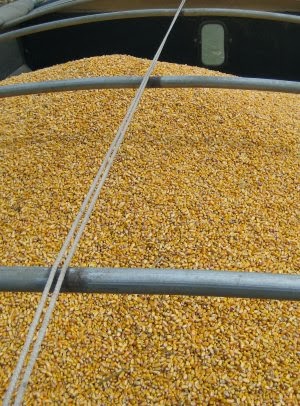
Corn Numbers on Food vs. Fuel

Chad Lee, Extension Agronomist, University of Kentucky

There is a lot of recent discussion about corn for food versus corn for fuel. Here are some numbers on corn in the United States that seem to be lost in this discussion

Based on 2011 estimates, corn for direct food consumption was about 5 to10% of total U.S. production. Fuel ethanol was 38%, feed and residual was 38%, and exports were 14%. (Source: USDA-ERS Yearbook).

Friday, November 1, 2013

Corn Knocked Down from High Winds

Chad Lee, Extension Agronomist, University of Kentucky

Corn downed by high winds on October 31, 2013.
Image courtesy Eric Baker
October left with a blast. High winds across the state blew in odd directions and over some corn fields. We knew this was going to be a risk this fall. The heavy ears, shallow roots and slow drydown all created a risk for downed corn. The high winds also brought rains, meaning that harvest will not resume for several days. What can we do now?

We can start by inspecting fields. Identify the fields where corn is down and fields where corn is standing. If corn is standing, check stalk strength with the grab test. (Grab the corn stalks at shoulder height, pull or push about 18 inches off center and release. If the corn stalks remain upright, stalk strength is good. If not, stalk strength is weaker.) Identify the grain moisture in all fields.

Freeze Damage to Soybeans and Harvest Options

Chad Lee, Extension Agronomist, University of Kentucky

Freeze Damaged Soybeans. Image courtesy of Curt Judy
The freezing temperatures wilted leaves and killed soybeans in some fields across Kentucky. Now that temperatures have warmed up again, we can better determine how to manage the crop from here.

The vast majority of soybeans were done growing and seeds were in the process of drying down. Those plants were at full maturity where the leaves had dropped, the pods were brown or tan and the seeds were yellow instead of green. Seed moisture was less than 20%. For those soybeans, the freeze events delayed drydown a little but did not harm the plants or the yield.

Wednesday, October 16, 2013

Harvesting very green corn for silage this season

Chad Lee and Carrie Knott, Extension Agronomists, University of Kentucky
Donna Amaral-Phillips, Extension Dairy Nutritionist, University of Kentucky


Farmers are chopping silage at the normal time on the calendar and commenting on the very green corn in the fields. Silage corn was planted late this spring and that delays corn development. The summer was cooler and cloudier than normal, which also delays corn development. Finally, there is a lot of biomass in the corn this year, so drydown may take a little longer. Corn chopping may need to be delayed several weeks this season to get corn to the proper moisture.

Wednesday, October 9, 2013

Wheat Drill Calibration Tables

Chad Lee, Extension Agronomist, University of Kentucky

As producers gear up for wheat planting, calibration of the seeder is extremely important. Below are two tables to use as quick references in the calibration process. Most producers are using drills with 7.5-inch row spacing. The first table calculates how much seed to collect in 50 linear feet from one row of the drill. Target populations of 30 and 35 seeds per square foot are used for the calculations. The needed seed weights are listed as ounces (oz.) and as grams.

Tuesday, October 8, 2013

Insect Considerations for Wheat Planting Decisions

Doug Johnson, Extension Entomologist

As I travel around the countryside, I see plenty of emerging corn in fields that will likely be planted in wheat. This “Green Bridge” could lead to problems with certain insects important to wheat Production. The insect pests we need to consider have not changed from previous years, but their relative importance may have changed from last year. Fall armyworm (FAW), Hessian Fly (HF), cereal aphid complex (CAC), and wheat curl mite (WCM) are annual threats. In most years, only the CAC is of major concern. In 2012 the FAW was a considerable problem in west Kentucky, not only in wheat,but also in many forage grasses.

Friday, October 4, 2013

Good Corn Yields Despite Nitrogen Losses

Chad Lee, Extension Agronomist, University of Kentucky

Excellent seed fill,
even though N deficiency is evident.

Corn in most fields across the state displayed nitrogen (N) deficiency before black layer was reached. Those losses were expected this season as we experience more rain. Normally, we expect yield losses to occur when the corn crop runs low on N before the seeds are done developing on the cob. However, walking some of these fields reveals that corn yields should be very good despite the apparent lack of N.